
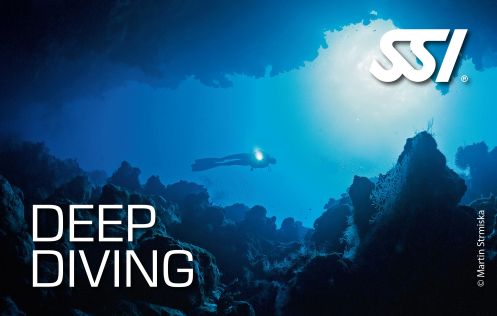
SSI Deep Diving
Standard Open Water limits aren't a wall, they're a starting point. Most divers never learn what changes on the other side of them.
Deeper diving isn't just descending further. Gas consumption changes, no-decompression time shrinks, the margin for error narrows. SSI Deep Diving teaches the planning that makes going deeper a deliberate, well-prepared decision.
Availability: In Stock

Going Deeper Is Not Just Descending Further. Everything About the Dive Changes With It.
You have stared at it more than once: the standard recreational depth limit, and whatever is just past it. Going deeper is not simply a matter of finning further down. Gas consumption changes faster, no-decompression time shrinks, and the margin for error narrows in ways that demand real planning, not just curiosity.
Tom’s SSI Deep Diving course, the deep diving certification (also searched as a deep diving course) for divers working toward a deep diver certification, builds that judgment across three progressive open water dives: 60-100 feet, 80-100 feet, then 100-130 feet, each one proving you can manage the added complexity before you go further. $249 per diver (group) or $349 (private). Bundle with Night & Limited Visibility for $395. Prerequisites: Open Water Diver, minimum age 15.
Wanting to Go Deeper Is Not Overconfidence. It Is a Natural Next Question.
If you have looked at your Open Water depth limit and wondered what is actually different below it, that curiosity is normal, not a red flag. Depth changes gas consumption, no-decompression time, and the margin for error, all of which this course is specifically built to teach you to manage.
This is not about proving you are advanced. It is about respecting a genuine increase in complexity with the specific planning and skills that make it manageable.
Is this you?
Deep Diving Is for the Diver Ready for a Real Step Up
Tap to expand
This is usually the right next step if any of these sound familiar.
Your travel destinations involve deeper dive sites
Many premier dive sites worldwide sit beyond standard Open Water limits. This certification opens them up.
You are working toward wreck or other Access-lane diving
Several Access-lane sites and specialties either require or strongly benefit from deep diving experience.
You want to understand what actually changes at depth
The course covers diving maladies, incident management, and the real physiology behind depth limits.
You want a structured way to extend your depth range
Three progressive dives, not a single jump, build comfort and competence incrementally.
Not sure?
Choose Your Next Access-Lane Step
Tap to expand
You want to go further down, not into something
Best for divers whose goal is extending depth range and managing the physiological factors that come with it.
You want structure, history, and a new kind of site
Best for divers drawn to man-made structures and the marine life and history that comes with them.
You want a different kind of challenge than depth
Best for nocturnal marine life and navigation in reduced visibility. Often bundled with Deep Diving.
Setting the record straight
What Deep Diving Actually Involves
Tap to expand
"This means rushing straight to 130 feet."
The course is structured as three progressive dives: 60-100 feet, then 80-100 feet, then 100-130 feet. Reaching maximum depth is secondary to proper planning and preparation at each stage.
"Deep diving is inherently very dangerous."
The specific risks of increased depth (gas consumption, narcosis, reduced no-decompression time) are well understood and directly addressed by this course’s training in planning, hazard awareness, and incident management.
"I need technical diving experience first."
This is a recreational specialty, not technical diving. Open Water certification and minimum age 15 are the only prerequisites.
"Once certified, I have to dive to 130 feet every time."
The certification extends your depth range up to 130 feet; it does not require you to dive that deep on every dive. You choose the depth appropriate for each specific dive.
What You’ll Train
Three progressive open water training dives, each building on the last.
Cover your Total Diving System at depth, special equipment and surface support, planning your deep dive, potential hazards, diving maladies, incident management, and repetitive deep diving.
The first dive emphasizes proper planning and preparation. Reaching depth is secondary to demonstrating sound dive planning.
Apply the planning and procedures from Dive 1 with increased depth experience, building comfort at the deeper end of the range.
The final dive extends to the certification’s maximum depth, integrating everything learned across the progressive sequence.
Course at a Glance
| Price | $249 per diver (group) · $349 per diver (private) |
| Bundle pricing | $395 when combined with Night & Limited Visibility (group) · $449 (private) |
| Format | Three open water training dives · online academics via MySSI app |
| Location | Lake Travis or Spring Lake |
| Prerequisites | Open Water Diver (any agency) · minimum age 15 |
| Certification awarded | SSI Deep Diving · lifetime certification, recognized worldwide · extends depth limit to 130 feet |
Ready for a real step up?
SSI Deep Diving: $249 · Austin, TX
Three progressive open water dives. Bundle with Night & Limited Visibility for $395.
Register Here Call Tom’s Email Tom’sWhere this fits in your pathway
Deep Diving Sits in the Access Pathway
Tap to expand
Access is for divers ready to reach new environments and greater depth or challenge. Deep Diving is one of the most direct entry points into this lane, since it expands the range of every other Access specialty you take afterward.
Optimize
Nitrox, computers, equipment, and other tools that make diving more efficient and extend your bottom time.
Access
Deep diving, wreck diving, decompression diving, sidemount, and other ways to reach new environments and depth.
Precision / XR
Extended range, technical wreck, and overhead environments for divers ready for a different category of training.
Why Tom’s Dive & Swim
We Build Divers We Would Trust With Our Own Families.
Tap to expand
The best divers don’t chase certifications. They build capabilities. Deep Diving rewards exactly that kind of careful, progressive preparation: the planning and judgment you build here carries directly into every deeper dive you take for the rest of your diving life.
Tom’s instructors bring real depth and incident management experience to every progressive dive, not just the academic curriculum. Tom’s has been Austin’s only SSI Dive Center since 1982. We were teaching scuba in Austin before any of the other Austin dive shops opened. Over 18,000 certified divers and over 400 five-star Google reviews.
Three Dives, Not One Jump
The progressive depth structure (60-100ft, 80-100ft, 100-130ft) builds genuine comfort and competence, not just a single deep experience.
Open Longer Than Any Other Austin Dive Shop Still in Business
Four decades of teaching divers to extend their depth range safely and confidently.
Pair With Night & Limited Visibility for $395
A popular Access-lane combination for divers building toward more demanding diving.
One of Austin’s Largest Instructor Teams
Flexible scheduling for your three progressive open water training dives.
We follow DAN dive safety protocols.
Tom’s follows Divers Alert Network (DAN) safety standards and recommends DAN dive accident insurance for every certified diver. Safety is not a checkbox on our website. It is the foundation of how Tom’s has operated since 1982.
Frequently Asked Questions
Tap any question to expand the answer.
Do I have to reach 130 feet to get certified?
The certification extends your depth limit to 130 feet, but the course emphasizes planning and preparation over reaching maximum depth. Your instructor will adjust dive depth based on conditions and your comfort level.
What is nitrogen narcosis and should I worry about it?
Narcosis is a well-understood physiological effect of depth that the course covers directly, including how to recognize it and plan around it. It is a normal part of deep diving education, not a hidden danger.
Can I combine this with Night & Limited Visibility?
Yes. Deep Diving and Night/Limited Visibility bundle for $395, a popular combination for divers building Access-lane capability.
Is this the same as technical diving?
No. This is a recreational specialty extending your depth limit to 130 feet within no-decompression limits. Technical diving (decompression diving, extended range) is a separate, more advanced pathway.
Is there a medical screening required?
Yes. All students complete an SSI Medical Statement before any in-water activity.
Book online, call, or email, whichever is easiest for you.