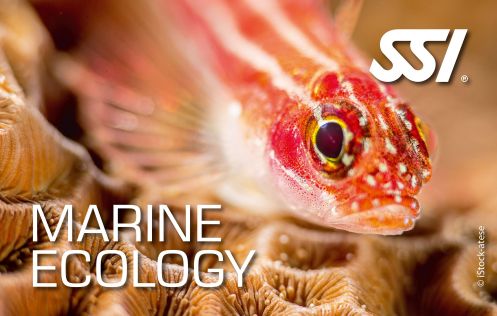
SSI Marine Ecology
A school of yellow fish flashes past. A patch of staghorn coral, a sponge, something purple in a crevice you don't have a name for. You log the dive and remember almost none of it specifically.
Marine Ecology teaches you to actually read a reef: the zones it belongs to, why certain life shows up in certain places, how everything from the intertidal to the deep sea connects. The fish do not change. What you notice does.
Availability: Contact us for booking information

A Reef Is Not Random. It Is Organized, and Once You Know How, You See It Differently.
A school of yellow fish flashes past. A patch of coral, a sponge, something purple in a crevice with no name attached. Most dives blur together this way, not because there was nothing to see, but because nothing you saw had context. A reef is not random. It is organized into zones, intertidal to deep sea, each with its own logic and its own relationships between species and environment.
SSI Marine Ecology teaches you to read that organization, so the next dive shows you a place with structure and story instead of color and motion. Self-paced academics, with an optional open water application dive. $150. Open to everyone, certified diver or not. Minimum age 10.
Open to every diver, every experience level
This Is Knowledge, Not a Skill Gap
Tap to expand
Marine Ecology is not about being a more advanced diver. It is about seeing more of what is already in front of you on every dive you have ever taken.
This course exists to make the ocean make sense, turning unfamiliar reef scenery into a place with logic, relationships, and stories you can actually follow.
Is this you?
Marine Ecology Is for the Diver Who Wants to Understand What They’re Looking At
Tap to expand
This is usually the right next step if any of these sound familiar.
You want to know why certain life shows up in certain places
Oceanic zones explain the patterns behind what you see, from shallow reefs to the open ocean.
You dive different regions and want context
Understanding ecology transfers across destinations, since the underlying zones and relationships are consistent worldwide.
You care about ocean health
Understanding the relationships in a reef ecosystem is the foundation for understanding what threatens it.
You want better subjects and context for your photos
Knowing where to look and what behavior to expect makes you a more effective underwater photographer.
Not sure?
Choose Your Explore-Lane Course
Tap to expand
You want the big picture of ocean zones
Best for understanding the overall structure of marine environments from intertidal to deep sea.
You want to understand conservation and threats
Best for divers interested in ocean health, conservation issues, and what divers can do about them.
You want the physics and physiology behind diving itself
Best for understanding why dive tables, pressure, and decompression work the way they do.
Setting the record straight
What Marine Ecology Actually Covers
Tap to expand
"This is just for science-minded divers."
No prior science background is needed. The course is written for divers, not marine biologists, and builds understanding step by step.
"This won’t change how I actually dive."
Most divers report their dives feel noticeably richer afterward, since they start recognizing patterns and relationships instead of just colorful blur.
"This is the same as Fish Identification."
Marine Ecology covers the big-picture structure (zones, relationships, oceanic systems). Fish and Coral Identification go deeper on specific species recognition.
"I need to be an advanced diver to take this."
There is no diving skill prerequisite. This is an academic course open to any certified diver, or even non-divers interested in marine science.
What You’ll Train
Primarily an academic course, with an optional open water application dive.
Work through the oceanic zones, from intertidal through deep sea, and the relationships and linkages between them, at your own pace.
A short digital exam confirms your understanding before certification.
An optional dive applying what you have learned to observe and identify zones and relationships in a real environment.
Course at a Glance
| Price | $150 |
| Format | Online academics via MySSI app · optional open water application dive |
| Prerequisites | None required for academics · Open Water Diver if completing the optional dive · minimum age 10 |
| Certification awarded | SSI Marine Ecology · lifetime certification, recognized worldwide |
Ready to actually understand the reef?
SSI Marine Ecology: $150 · Austin, TX
Self-paced academics, open to every diver.
Register Here Call Tom’s Email Tom’sWhere this fits in your pathway
Marine Ecology Sits in the Explore & Enrichment Pathway
Tap to expand
Explore & Enrichment is about conservation and knowledge, open to everyone regardless of experience level. Marine Ecology is the foundation course for the entire lane.
Control / Comfort
Buoyancy, navigation, boat procedures, and other confidence-building skills.
Explore & Enrichment
Marine ecology, fish and coral identification, and other ways to understand what you are seeing underwater.
Optimize
Nitrox, computers, equipment, and other tools that make diving more efficient once your basics are dialed in.
Why Tom’s Dive & Swim
We Build Divers We Would Trust With Our Own Families.
Tap to expand
The best divers don’t chase certifications. They build capabilities. Marine Ecology is a direct example: understanding what you are looking at is itself a capability, one that makes every single dive afterward more rewarding.
Tom’s teaches ecology with a focus on what you will actually encounter diving in Texas and on travel destinations, not abstract theory. Tom’s has been Austin’s only SSI Dive Center since 1982. We were teaching scuba in Austin before any of the other Austin dive shops opened. Over 18,000 certified divers and over 400 five-star Google reviews.
Built Around What You’ll Actually See
Curriculum connects directly to the kinds of dives Austin divers actually do, locally and on travel.
Open Longer Than Any Other Austin Dive Shop Still in Business
Four decades of helping Austin divers understand and appreciate what they are seeing underwater.
No Prerequisites Required
Academics are open to anyone curious about marine science, certified diver or not.
One of Austin’s Largest Instructor Teams
Available to answer questions and discuss the material beyond the self-paced curriculum.
We follow DAN dive safety protocols.
Tom’s follows Divers Alert Network (DAN) safety standards and recommends DAN dive accident insurance for every certified diver. Safety is not a checkbox on our website. It is the foundation of how Tom’s has operated since 1982.
Frequently Asked Questions
Tap any question to expand the answer.
Do I need to be certified to take this course?
No. The academic portion is open to anyone. You only need Open Water certification if you choose to complete the optional open water application dive.
How long does the course take?
Most divers complete the academics in a few hours of self-paced study through the MySSI app.
Is this the same as Fish or Coral Identification?
No. Marine Ecology covers the big-picture structure of ocean zones and relationships. Fish and Coral Identification are separate, more specific courses.
Will this make me a better diver?
It will not change your in-water skills, but most divers report their dives feel significantly richer once they understand what they are looking at.
Can I bundle this with other Explore courses?
Call (512) 451-3425 to ask about current Ecology Class bundle pricing for combining multiple Explore-lane courses.
Book online, call, or email, whichever is easiest for you.